Sounds of Kavala and Thassos
Like everywhere in Greece, Kavala and Thassos reveal their full identities through the people who live there. In Kavala, maritime traditions, local food and wine, and a quietly vibrant creative scene continue to thrive. And on Thassos, the island just opposite Kavala, local flavours, marblework and ancient history are revealed in much the same way: through voices that invite you to share their world. Our podcast series, Sounds of Kavala & Thassos, gathers these personal stories, revealing a way of life deeply connected to memory and place.
Sounds of Kavala
Episode 1 – Catch of the Day: Kavala’s Fishing & Maritime Traditions
The sea isn’t just a backdrop in Kavala. It shapes the identity, lives and livelihoods not just of the city, but of its people. Captain Giorgos Pagonis has spent his life on the water. “I was born and raised on a boat – simple as that,” he says, recalling how the sea has come to represent belonging as much as survival – first as a fisherman’s son and then as a fisherman himself. Today, he opens that world to visitors on fishing excursions, where he shares what it means to be connected to the sea.
Christos Tzanakos brings another perspective to a port city shaped by the flow of people and goods. After decades as a mariner, he returned and founded the Maritime Museum of Kavala, gathering objects, photographs and stories that trace the city’s long relationship with the sea. “The old sailors immediately embraced the idea,” he recalls. “They gave us their memorabilia, made donations. They said, ‘Your grandchildren… your children will come and ask, ‘What is this? A sextant? What will we do with it? Throw it away?’ And that’s how this whole maritime history and tradition would be lost.”
Between them, the experience and memory of Kavala’s maritime world come to life – personal, historical and constantly evolving.


Episode 2 – Culinary soul: Kavala’s harvest & heritage
For other residents of Kavala – such as Avgi Chrysanthidou – the strongest connections with the past come in flavours passed down from past generations. At her family’s workshop in Nea Karvali, just outside the city, her recipe for kourabiedes (rich, buttery and crunchy biscuits) carries the spirit of the Greek families who arrived as refugees from Asia Minor in the 1920s. “It passed through the hands of my grandmother, to my mother, from there to us… and went on to our children, but without losing anything – neither the taste nor the memory,” she says.
It’s a sentiment echoed by Prodromos Iosidis, founder of another delicious-smelling kourabie workshop close by. “I started making kourabies 50 years ago,” he tells us. "My father had bought a bakery. Until I was twenty, I made bread. After the army, I got married and my wife and I started making kourabies – using grandma’s recipe."
Meanwhile, on the slopes of Mount Pangaio, where winemaking stretches back to the cult of Dionysus, Vasilis Tsaktsarlis tends his vineyard at Ktima Biblia Chora. The combination of Mediterranean climate and fertile land shapes the character of the wines, while knowledge passed down over time guides each decision in the vineyard and cellar.
When you take care of the vineyard, it takes care of you
It was Chrysanthi Oikonomidou, the estate’s Head of Tours, who showed us around the winery with a welcoming smile and reflections of her own. “The name of the estate, Biblia Chora, is the ancient name of our region, derived from a grape variety called Vivlia vine, which had been brought here by the Ancient Phoenicians,” she explained. “Later, it was cultivated by the Ancient Greeks to such an extent that the wider area became known as ‘Biblia Chora’.
Together, they show how Kavala’s flavours are shaped as much by history as by location.


Episode 3 – Arts & Culture: Kavala’s young creators
Creativity in Kavala often begins with the city itself. At Mantility, for instance, silk becomes a canvas for collaboration, bringing together artists and designers. As founder Vasiliki Zafeiria Ipsilanti explains, designers are encouraged to “create without restrictions, as long as their work is eventually translated onto silk”. Drawing on the long tradition of silk-making in northern Greece, each piece carries a personal expression shaped by the light and colours of the world around them.
Meanwhile, in the studio of local potter Stella Rokou at Gaia Ceramics, the process is even more tactile. Clay is shaped by hand and experience, with patience and physical self-expression. “I love that everything is really close to me – the sea, nature, being able to walk around,” she says about living in Kavala and she passes that enthusiasm onto her students: “When they arrive, they’re often very tired and stressed. But by the time the two-hour class is over, they leave like different people, happy, optimistic.”
Turning to theatre, Eva Oikonomou-Vamvaka tells us about her experience as the Artistic Director of the Philippi Festival. She talks about how theatre-goers are inspired by both the ancient drama and the setting at the Ancient Theatre of Philippi by Mount Pangaio. But she also tells us about the initiative to commission new groups and emerging directors to create new festival productions at alternative venues in Kavala. “It’s important to me that the festival’s productions have a unique character – that they come from the city and are made for the city,” she says.
Together, they reveal a creative scene shaped as much by place as by practice.


Sounds of Thassos
Episode 4 – Beneath the Surface: Unearthing ancient Thassos
The ancient world is never far away on Thassos. Archaeologist Tasos Kakamanoudis was originally from Kavala and described how Thassos was always the island opposite – mystical and changing colours, especially at sunset. Now living on the island, he tells the story of the origins of Thassos – both mythical and real – and of the cults of the first settlers. “They came from Paros, as early as the 7th century BC, bringing with them their gods – Apollo, Artemis, Dimitra, Dionysus, Poseidon, Hercules and others,” he tells us. “By bringing their cults, they essentially helped create the city itself.” He describes the excavations of the ancient city and reflects on the finds now housed in the Archaeological Museum of Thassos, including a striking statue of Alexander the Great.
Anastasios Billias grew up literally within the ruins of Ancient Thassos. “We were right there next to the ancient marbles, the ceramics, the coins,” he says. “When it rained, we’d go out and find coins or fragments of oil lamps. History touched us so deeply that we wanted to learn about the people who came before us.” He also reflects on the work of the French School at Athens, whose systematic digs in the early 20th century brought to light the structure of the ancient city – its public spaces, monuments and everyday traces.
Together, their voices reveal a past that remains tangible and closely tied to the experience of visiting Thassos today.


Episode 5 – Honey & Olive Oil: Thassos in a jar
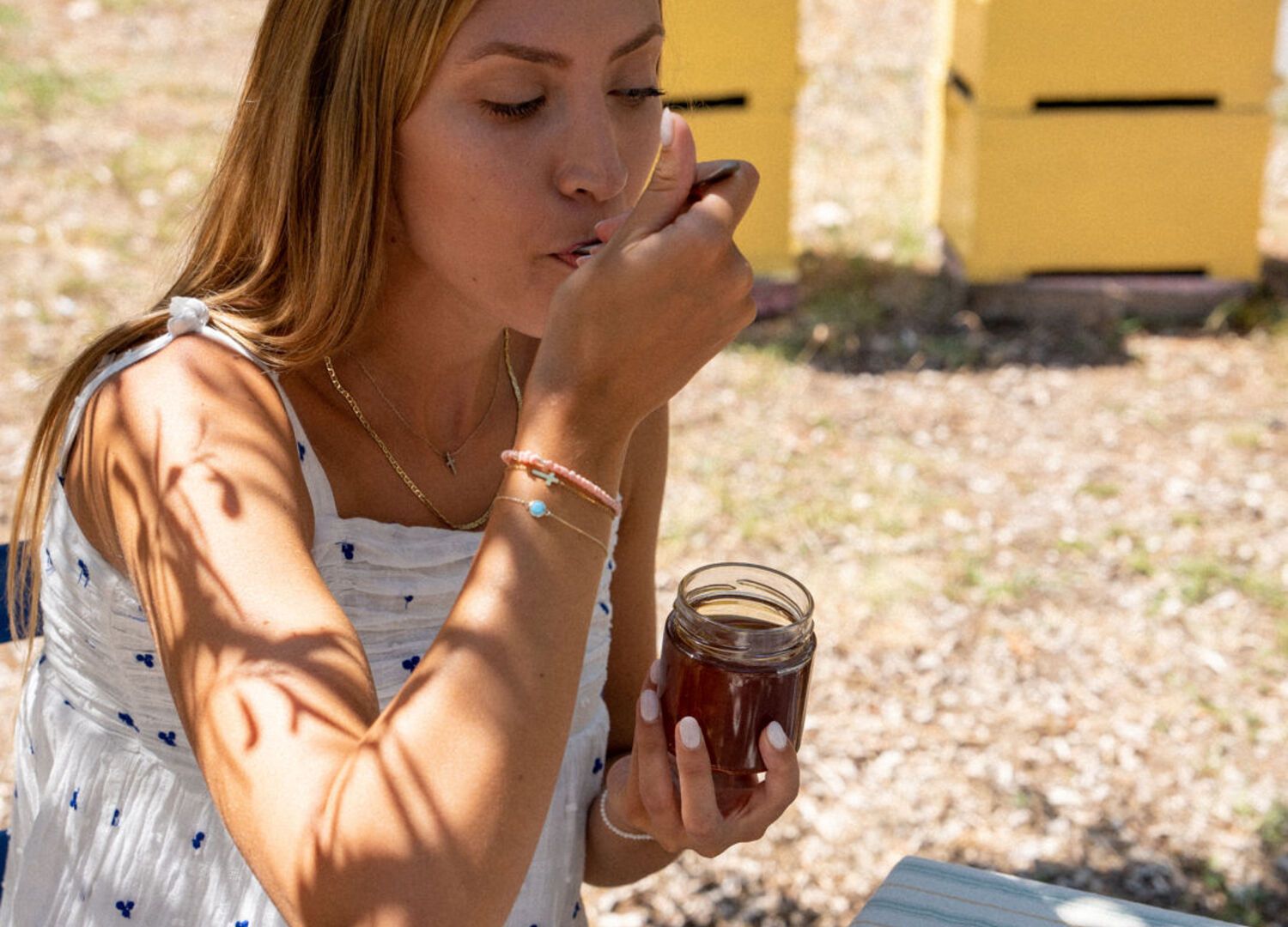
Flavour is part of everyday life on Thassos. Kostas Panagiotopoulos, president of the Thassos Beekeepers’ Cooperative in Prinos, and fellow beekeeper Dimitris Koutlis of Koutlis Honey in Lefki reveal a way of life shaped by patience and close attention to nature. “If you form a bond with this work, you love it… You don’t care about money,” says Kostas. Together, they show how the island’s renowned pine honey is shaped by generations of know-how, the seasonal movement of hives and a landscape almost entirely covered in pine.
Olive oil tells another story of continuity. At the historic Sotirelis family mill in Panagia, Kleopatra Paplomata shares the tradition of olive production on Thassos – from traditional water-powered mills to modern cold-press techniques – and explains how the island’s native throuba olive produces a golden yellow oil with a distinctive, lightly peppery finish. “Whoever tries good quality raw olive oil… I don’t think can ever change to something else,” she says.
Between them, honey and olive oil capture Thassos in its purest form.



Episode 6 – Carved by Time: Thassos’ snow-white marble
On Thassos, marble begins deep within the island itself. At an active quarry, geologist Charalambos Philippidis explains how its distinctive whiteness and clarity are shaped by its crystalline makeup, giving Thassian marble a lustrous quality valued since antiquity. “It has a remarkable property… It reflects the light,” he notes, describing the ancient quarries that were active from the 6th century BC to the 6th century AD. He describes the extensive use of Thassian marble locally and in ancient sites on the mainland, such as Amphipolis.
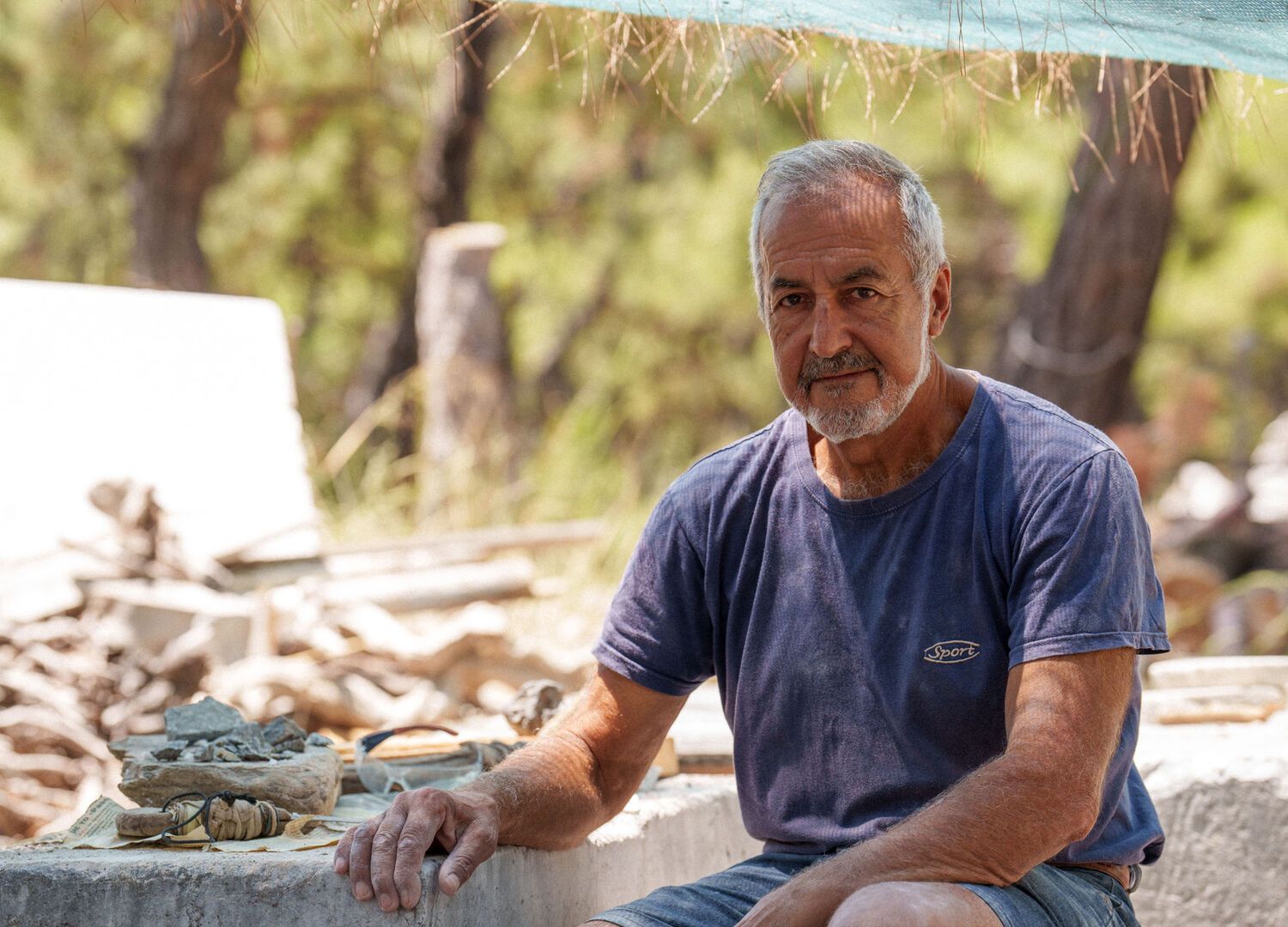
Meanwhile, in Limenaria, sculptor Kostas Lovoulos works with marble in a more intimate way. He describes a creative process that requires equal measures of patience and inspiration. “When a block of marble arrives – square, solid, a mass … I have to know what it holds inside,” he says. “I have to think about what exists within it in order to bring it out.” He also notes that the ancients were more skilled at the craft than any sculptor today.
Through them, we see how Thassian marble has moved through time, carrying the island’s identity with it.



Sounds of Kavala & Thassos
Each of our episodes offers a way to experience Kavala and Thassos through the people who know them best. Follow their stories and discover how everyday life creates a deeper connection to two holiday destinations in northern Greece.