A walking tour of the Exoches quarter of Thessaloniki
OVERVIEW
The Exoches district of Thessaloniki – also known as Pirgi (or Towers) – reflects the moment Greece’s second-largest city expanded beyond its old boundaries and embraced a more cosmopolitan identity. Its story began to take shape in the late 19th century, as Thessaloniki expanded beyond its old walls and, under the pressure of housing needs following the fire of 1890, gradually developed into an affluent suburb of villas.
The result was that Thessaloniki began to develop eastwards along the Thermaic Gulf, including a prestigious suburb of grand villas with gardens laid out along what was then Exochon Street – today’s Vasilissis Olgas Avenue.
During Ottoman times, the area was known as Hamidiye (after Abdul Hamid II), although the nickname Yalilar (mansions) better captured its character. Wealthy residents settled here – Greeks, Jews, Muslims and others living side by side. But unlike the historic centre, where neighbourhoods often grew around places of worship, Thessaloniki’s Exoches district was shaped by social and economic choice: prestige, comfort, distance from the crowded city and proximity to the sea.
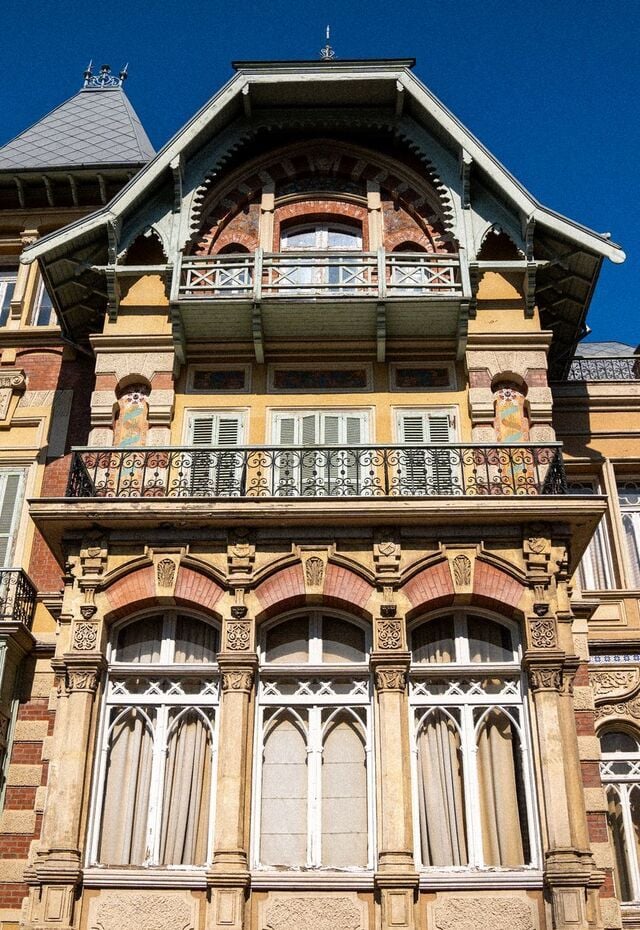
The diversity and status of the residents were mirrored in the eclectic architecture of the houses: neoclassical villas of Greek owners, art nouveau and central European influences elements, the Ottoman baroque style of Muslim officials, and even the chalet-like buildings favoured by Jewish families. The result was a district that expressed education, wealth and ambition.
The 20th century brought major change. Thessaloniki was incorporated into the Greek state in 1912, and successive population shifts – including the destruction of the Jewish community during the Second World War – reshaped the district. Of those that have survived, many are listed and some now house cultural institutions or municipal services. Together, they keep alive the memory of a district rooted in the city’s multicultural past.
BE INSPIRED
DON'T MISS
Villa Hatzimisef & Villa Modiano
These two neighbouring properties on Vasilissis Olgas Avenue are excellent examples of the symmetry, classical detailing and sense of scale typical of the Exoches district’s early villas. Today, they share a common courtyard and house a high school.
Villa Hatzimisef was built between 1890 and 1896 for Theodoros Hatzimisef, honorary interpreter of the Russian consulate and one of the city’s wealthiest merchants. It was, by most accounts, designed by Frederic Charnot, a French architect active in Thessaloniki at the turn of the 20th century, whose work helped define the city’s changing architectural character. It is a two-storey neoclassical residence combining restrained classical detailing with eclectic features. Look out for the memorial plaques by the entrance commemorating Jewish students deported during the Second World War.
Next door, Villa Modiano was built around 1900 for Joseph Modiano, a prominent member of one of Thessaloniki’s most influential Sephardic Jewish families (you’ll also find the name in the Modiano Food Market, completed in 1930 by architect Eli Modiano). Restored and reopened in 2016, Villa Modiano retains its elegant façade and richly decorated interiors, including ceiling frescoes.
Folklife and Ethnological Museum of Macedonia–Thrace
Another residence of the Modiano family on Vasilissis Olgas Avenue, this elegant mansion now houses the Folklife and Ethnological Museum of Macedonia-Thrace. It was built in 1905-1906 as the private home of banker Jacob (Jacko) Modiano and designed by Eli Modiano. It is a fine example of eclectic architecture enriched with Art Nouveau elements and reflects the refined urban lifestyle that characterised Thessaloniki’s Exoches district in the early 20th century.
After the city’s liberation from the Ottomans, the villa passed into the hands of the Greek state and served various administrative functions before being restored and converted into a museum. Today, it hosts exhibitions exploring everyday life and customs of northern Greece, including displays on traditional watermills and regional costumes from 1860–1960.
The Kapandji villas
Villa Mehmet Kapandji, at 108 Vasilissis Olgas Avenue, was built between 1893 and 1895 for the Kapandji family to designs by Italian architect Pietro Arrigoni. It is a fine example of late-19th-century eclecticism, combining European influences with chalet-like forms, most evident in its scale and roofline. The villa is closely linked to key moments in the city’s modern history. It housed Prince Nikolaos as the city’s first military governor in 1912-1913 and, in 1917, served as the headquarters and residence of Prime Minister Eleftherios Venizelos. Over the decades, it was also used as refugee accommodation, a military bakery and a secondary school. Restored in the 1980s, it now operates as a cultural centre of the National Bank of Greece Cultural Foundation (MIET), hosting exhibitions, lectures and educational programmes.
Nearby, at 105 Vasilissis Olgas Avenue, is Villa Ahmet Kapandji, another residence designed by architect Pietro Arrigoni for the Kapandji family. It was requisitioned by the Nazis during the war and served as a Nursing School of the Greek Red Cross and, later, NATO offices. Renovated towards the end of the 20th century, it has also served various cultural and regulatory functions.
Marokos Mansion
Standing at the junction of Vasilissis Olgas Avenue and Petrou Syndika Street, Marokos Mansion was built in 1906 by Austrian insurance agent Ioannis Marokos. It is said to have been intended as a dowry for his daughter, Maria Theresa – a reminder of the family wealth that shaped Exoches at the time. The house did not remain long in the Marokos family and was later sold to the Bourla family of Thessaloniki’s Jewish community. In 1951 it passed to the Greek state. Declared a listed monument in 1985, it was later restored and now operates as a café and cultural venue. Architecturally, it reflects the district’s eclectic character, with generous openings, high ceilings and refined wooden detailing.
Villa Mordoch
Villa Mordoch stands at the junction of Vasilissis Olgas Avenue and 25th Martiou Street and is another example of early 20th-century residential architecture in Exoches. It was built in 1905 for Seifullah Pasha and later took its name from Samuel Mordoch, after Thessaloniki was incorporated into the Greek state.
Architecturally, it reflects the district’s eclectic character, combining neoclassical, baroque and Art Nouveau elements. Its corner tower, crowned by a dome, makes it a recognisable landmark along the avenue. It was requisitioned during the Nazi occupation and during the 1960s was chosen to house the Municipal Art Gallery of Thessaloniki. Today it accommodates municipal services.
Casa Bianca
Also known as Villa Fernandez or Villa Blanche, Casa Bianca stands at the junction of Vasilissis Olgas and Themistokli Sofouli streets. It was built between 1911 and 1913 to designs by Italian architect Pietro Arrigoni for the merchant and banker Dino Joseph Fernandez Diaz. The mansion takes its name from his wife, Blanche “Bianca” de Mayer, and remains one of the most recognisable examples of eclectic architecture in Thessaloniki.
During the Occupation, it was requisitioned first by the Italian and later by the German forces. After the war and several different uses, it passed to the Municipality of Thessaloniki in 1990. Today it houses the Municipal Art Gallery, exhibiting painting, printmaking and sculpture by Greek artists of the 19th and 20th centuries, with particular emphasis on modern Greek printmaking. A café in the garden makes it an inviting stop along the way.
Villa Allatini
Villa Allatini dates to 1888 and takes its name from the Allatini family, one of Thessaloniki’s most influential Jewish families at the turn of the 20th century. Their business ventures (most notably the Allatini Mills, a vast industrial complex near Exoches that still stands today on Georgiou Papandreou Avenue) played a significant role in the city’s economic life. The villa itself was designed by Italian architect Vitaliano Poselli. With its symmetrical façade and neo-Renaissance character, it recalls the urban palazzi of 19th-century Italy and stands out for its measured proportions and formal presence. Over the decades, it has served a range of public and private functions. Inside, preserved decorative details and generous reception rooms hint at the scale and social life that once defined Exoches’ grand residences.
Bonus:
Yeni Mosque
A short walk off Vasilissis Olgas Avenue, on Archeologikou Mousiou Street, stands the Yeni Mosque – a reminder of the district’s Ottoman past. It was built in 1902 by Italian architect Vitaliano Poselli for the Dönme community – descendants of Jews who had converted to Islam – and was the last mosque constructed in Thessaloniki under Ottoman rule. Religious services continued until the population exchange between Greece and Turkey after 1923, when Muslims left the city and Orthodox Christian refugees arrived from Asia Minor.
It was then used as temporary refugee accommodation before becoming the city’s Archaeological Museum from 1925 to 1963. Architecturally, it reflects the same eclectic spirit seen in the Exoches villas, combined with distinct Ottoman features. Today, it hosts exhibitions and cultural events, and its courtyard displays ancient marble sculptures.
See the Getting There section for more information, including the address of each villa.
GET PLANNING
What are the addresses of the historic villas of Thessaloniki’s Exoches district?
- Villa Hatzimisef & Villa Modiano - 3-5 Vasilissis Olgas Avenue
- Folklore and Ethnological Museum of Macedonia-Thrace - 68 Vasilissis Olgas Avenue
- Villa Ahmet Kapandji: 105 Vasilissis Olgas Avenue
- Villa Mehmet Kapandji: 108 Vasilissis Olgas Avenue
- Marokos Mansion: 133 Vasilissis Olgas Avenue
- Villa Mordoch: 162 Vasilissis Olgas Avenue / corner of 25th Martiou Street
- Casa Bianca: 180 Vasilissis Olgas Avenue / 2 Themistokli Sofouli Street
- Villa Allatini: 198 Vasilissis Olgas Avenue
- Yeni Mosque: 30 Archeologikou Mousiou Street
How do you get to Thessaloniki?
Thessaloniki has an airport, receiving regular international and domestic flights throughout the year, and is connected to Athens by the Greek National Highway (A1) (500km, 5hr 30min by car). There are also land entry points between Greece and Bulgaria at the Promachonas border station (111km, 1hr 25min from Thessaloniki), Turkey at the Kipi border station (337km, 3hr 20min) and North Macedonia at the Evzoni border station (81km, 1hr 5min). Finally, there are regular connections from Athens to Thessaloniki by public bus (KTEL) and train.
How do you get around Thessaloniki?
Getting around Thessaloniki is easy – whether by taxi, public transport or on foot. The city also has a recently opened metro system, with Evklidis station as the closest stop to Vasilissis Olgas Avenue. See here for more information on the Thessaloniki metro.
When is the best time to visit Thessaloniki?
- Thessaloniki is an excellent city break destination at any time of year or a natural stopover for holidays in Halkidiki or elsewhere in northern Greece.
- Holidays in Thessaloniki are most enjoyable in spring, early and late summer, and autumn, when temperatures are milder than during peak summer (July-August).
- Autumn
- Spring
- Summer
- Winter
How long does it take to explore the Exoches quarter of Thessaloniki?
Your walking tour of the villas of Thessaloniki’s Exoches district follows almost the full length of Vasilissis Olgas Avenue, covering 3.7km and taking around 1.5 hours.
Admission information: